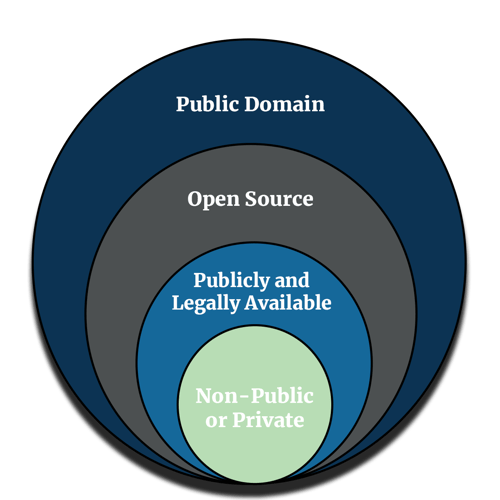
| Types of Information |
Definition |
Examples |
Included (Y/N) |
| Public Domain Information |
Everything that is not protected by copyright or as intellectual property, i.e., can be freely used by anyone without permission. |
Search engine result (ie: Google) |
Y |
| Open Source Information |
Information that is made available for “public consumption” and typically has an owner. Typically, this data is free, but may be subject to some licensing and copyright requirements. |
- Distributed to a public audience (e.g. news)
- Could be seen or heard by any casual observer
- Made available at a meeting open to the public
- Obtained by visiting any place or attending any event that is open to the public
|
Y |
| Publicly and Legally Available Information |
The term includes data that is public domain and open source. The difference is this is data that anyone may legally access – some of which may be only available upon request. Some information may require a subscription or fee to access. Differs from public domain in that some of that information may be protected by copyright, privacy or intellectual property regulations. |
- Public records such as company registrations, court databases, proprietary databases such as PEP lists
- Subscription/fee-based media such as industry journals, specialty publications, etc.
|
Y |
| Non-Public or Private Information |
Confidential data that typically should not be available for anyone’s access without an explicit consent. |
- Personal Identifiable Information such as medical history, social insurance/security numbers, identification numbers, etc.
- Private companies’ financials
- Legal documents
|
N |